
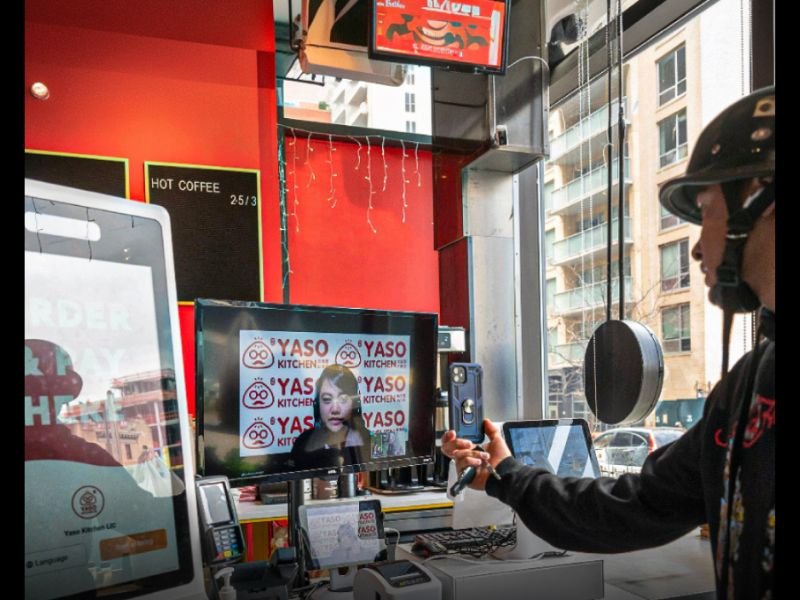
New York Restaurants Hire Remote Cashiers From the Philippines for $3.75 an Hour via Zoom
NEW YORK CITY — In a move that’s sparking nationwide debate, some New York restaurants are now hiring cashiers from the Philippines who work remotely via Zoom — earning about $3.75 an hour while taking customer orders from thousands of miles away.
Customers who visit these restaurants walk up to a digital kiosk or tablet where a live video call connects them to a remote cashier located overseas. The cashier takes their order in real time, entering it directly into the restaurant’s system — much like an in-person worker would.
Restaurant owners say the new model helps them cut costs and stay operational as rent and wages continue to rise in one of the world’s most expensive cities.
A Creative Fix for Rising Costs
With New York’s minimum wage now at $16 per hour, small business owners have been struggling to balance payroll costs with inflation, utilities, and supply chain challenges. For many, outsourcing customer service roles like cashiering has become an economic lifeline.
“It’s either innovate or close down,” one restaurant owner told Evolving AI. “We’re not replacing people entirely — we’re just trying to survive.”
The remote cashiers, based in the Philippines, work through platforms that coordinate shifts and manage video connections. They handle orders, process payments, and even respond to customer questions — all via Zoom.
Ethical Questions and Labor Concerns
While the idea has been hailed as “cost-efficient globalization”, critics argue it raises serious ethical and labor issues. Workers in the Philippines are being paid less than one-fourth of New York’s minimum wage, despite performing the same job functions as local employees.
Labor advocates have called the trend “digital offshoring” — a new form of outsourcing that allows employers to skirt domestic wage laws under the guise of remote technology.
“It’s a modern loophole,” said labor analyst Carla Ramirez. “Technology shouldn’t become a tool to undercut fair wages or displace local jobs.”
The AI and Automation Angle
Beyond wage ethics, experts warn that this practice could accelerate AI automation in the food industry. If a human can already handle transactions remotely, the next step — integrating AI voice and vision systems — could eliminate the need for human cashiers entirely.
View this post on Instagram
The same technology infrastructure could easily be adapted for speech recognition and facial identification, allowing automated systems to take orders, identify customers, and process payments — no human interaction required.
“Once you’ve proven a job can be done remotely through a screen,” said tech consultant James Lin, “it’s only a matter of time before AI does it faster and cheaper.”
Balancing Innovation and Humanity
The rise of remote cashiers signals a broader transformation in the restaurant industry, where efficiency and survival often outweigh traditional in-person service values. But as experts point out, such changes must come with ethical accountability.
For now, the Filipino cashiers behind the screens represent both a technological success and a human dilemma — offering a glimpse into a future where globalization, automation, and survival economics all collide at the checkout counter.
For more on evolving business and labor trends across the U.S., follow NapervilleLocal.com.

I’ve lived in Naperville long enough to see how quickly our community changes — from new developments downtown to sudden shifts in our Midwest weather. Reporting on Naperville news and daily forecasts gives me the chance to keep neighbors informed about what really matters. My goal is simple: deliver clear, timely updates so you always know what’s happening in our city and what to expect from the skies above.