
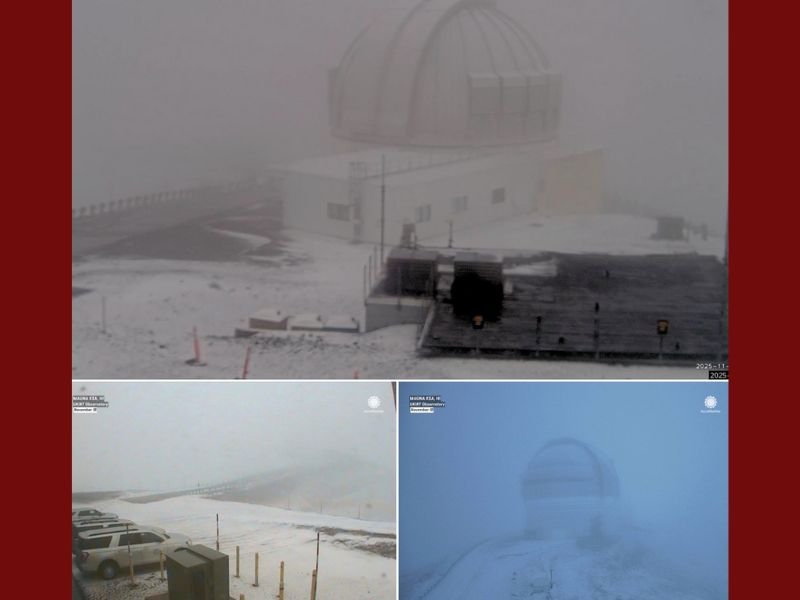
Hawaii’s Mauna Kea Sees Rare November Snowfall as Winter Weather Advisory Issued for Summit
MAUNA KEA, HAWAII — In a rare tropical twist, snow is falling on the summit of Mauna Kea, Hawaii’s tallest mountain, transforming the peak’s observatories into a wintry landscape more reminiscent of the Rockies than the Pacific.
The National Weather Service (NWS) has issued a Winter Weather Advisory for the island’s highest elevations, forecasting up to 4 inches of snow along the summits of Mauna Kea and Mauna Loa. The advisory, which went into effect Monday, warns that freezing temperatures and icy conditions could make travel to the summits extremely hazardous.
A Rare Weather Sight in the Tropics
While snow on Hawaii’s summits isn’t unheard of, it’s still an unusual and dramatic event in mid-November. At over 13,000 feet above sea level, Mauna Kea is often cold enough to receive snow when upper-level storms sweep across the Pacific.
Webcams from the UKIRT Observatory and Mauna Kea Weather Center showed the mountaintop coated in a thin but steady layer of white snow, with low visibility and strong winds gusting across the summit. Temperatures dropped well below freezing as the system moved through.
“Even though we’re in Hawaii, conditions up here can look and feel like the Arctic,” one Mauna Kea ranger said, warning visitors to avoid traveling to the summit during the advisory.
Winter Weather Conditions at the Summit
According to forecasters, this event is linked to a passing upper-level trough, which brought moisture and instability over the Big Island. As cold air filtered into the upper atmosphere, precipitation transitioned to snow above 12,000 feet.
The NWS warned of:
- Freezing rain and snow near Mauna Kea and Mauna Loa summits
- Wind gusts exceeding 40 mph, reducing visibility in blowing snow
- Icy road conditions and possible closures of summit access roads
The Mauna Kea Access Road is currently restricted to authorized personnel only, as rangers monitor visibility and ice accumulation.
A Reminder of Hawaii’s Extreme Elevations
Despite being a tropical paradise, Hawaii’s Big Island has one of the most extreme elevation ranges on Earth — from sea level to nearly 14,000 feet. That means visitors can surf at the beach in the morning and, on rare days like this, see snow by afternoon.
This event marks one of the earliest measurable snowfalls of the 2025–2026 winter season in Hawaii. While light accumulations are expected to melt quickly, more winter weather could develop in the coming weeks as colder systems sweep through the Pacific.
Stay with NapervilleLocal.com for continued updates on rare weather events and climate shifts around the world.

I’ve lived in Naperville long enough to see how quickly our community changes — from new developments downtown to sudden shifts in our Midwest weather. Reporting on Naperville news and daily forecasts gives me the chance to keep neighbors informed about what really matters. My goal is simple: deliver clear, timely updates so you always know what’s happening in our city and what to expect from the skies above.