
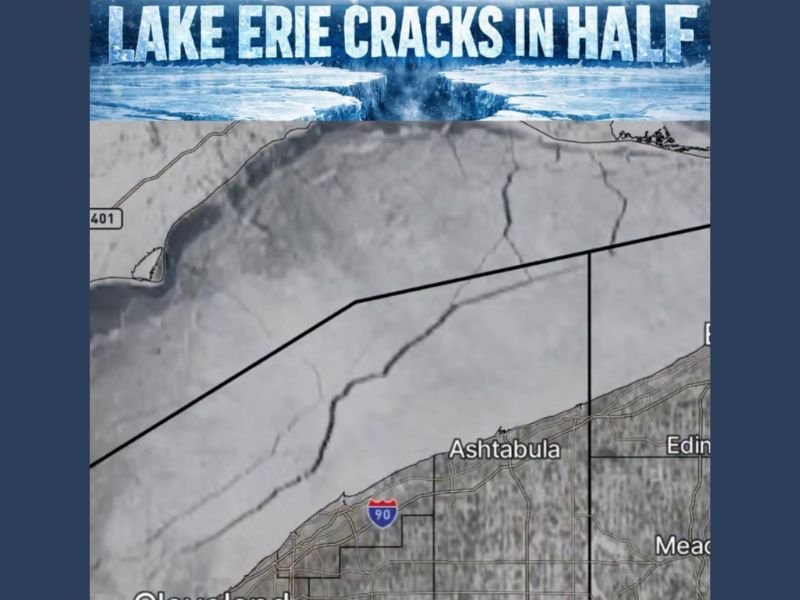
Ohio and New York See Lake Erie Ice Crack “In Half” on Satellite as Near-Record Ice Cover Meets Strong Winds
OHIO — A dramatic new crack has opened across Lake Erie’s ice sheet, with satellite imagery showing what observers described as the lake’s ice “cracking in half” as a burst of stronger winds pushed in behind a cold front. The scene is unfolding along the Lake Erie shoreline near Cleveland and Ashtabula, while attention is also focused farther east toward Buffalo, New York, where the lake’s ice coverage has been building during a stretch of prolonged cold.
The post accompanying the imagery notes that Lake Erie’s ice sheet is near record ice cover after an extended period of bitter temperatures. As winds increased, the stress on the frozen surface intensified—creating a sharply defined fracture line visible from above.
What the imagery shows across Lake Erie
The graphic highlights a long, dark line slicing through the otherwise pale, ice-covered surface—an unmistakable signature of a fresh crack in the lake ice. The map labeling places the feature in the Lake Erie corridor near Cleveland and Ashtabula on the Ohio side, with the broader context pointing to Lake Erie’s basin where wind-driven movement can quickly reshuffle ice.
The caption also credits NOAA / Weather Front imagery, indicating the crack was identifiable from satellite views rather than just shoreline observation. That’s significant because many lake-ice changes happen gradually or out of sight—until a clear satellite pass reveals how extensive the break really is.
Why Lake Erie ice can crack so dramatically
Lake Erie is the shallowest of the Great Lakes, which makes it more likely to freeze over in winter compared with deeper lakes. When prolonged cold locks in ice coverage and a cold front sweeps through, the change in wind speed and direction can force large ice sheets to shift, flex, and separate.
In this case, the description points to two key ingredients working together:
- Extreme, prolonged cold helping build widespread ice coverage
- Increasing winds behind a cold front pushing and stressing the ice sheet until it fractured
Even when the lake looks “solid” from a distance, the ice is constantly responding to changing wind and pressure—especially when it’s spread out across a massive surface.
What people near Cleveland, Ashtabula, and Buffalo should keep in mind
A crack like this doesn’t automatically mean the ice is about to break apart everywhere—but it does underline how quickly conditions can change on large bodies of water.
If you’re near the shoreline, the safest approach is to treat the lake ice as unstable, especially during or after windy periods. Cracks can widen, shift, or refreeze unevenly, and pressure can create jagged ridges and weak zones that aren’t obvious until you’re already too close.
Safety reminder as ice features evolve
Events like this are also a reminder that dramatic ice formations and fractures may look impressive—but they can be dangerous in real time. Wind-driven ice can move unexpectedly, and separation lines can create unstable boundaries where the ice thickness varies sharply over short distances.
For more weather updates, striking satellite imagery breakdowns, and regional conditions making headlines across the U.S., follow along at NapervilleLocal.com.

I’ve lived in Naperville long enough to see how quickly our community changes — from new developments downtown to sudden shifts in our Midwest weather. Reporting on Naperville news and daily forecasts gives me the chance to keep neighbors informed about what really matters. My goal is simple: deliver clear, timely updates so you always know what’s happening in our city and what to expect from the skies above.