
Florida Coast Shrouded in Dense Fog as Visibility Drops to Zero from Crystal River to Sebring
Tampa Bay, Florida — Visibility levels are dropping rapidly across portions of west-central Florida as low clouds and dense fog develop east of the coast, creating hazardous travel conditions from the Nature Coast south through inland communities.
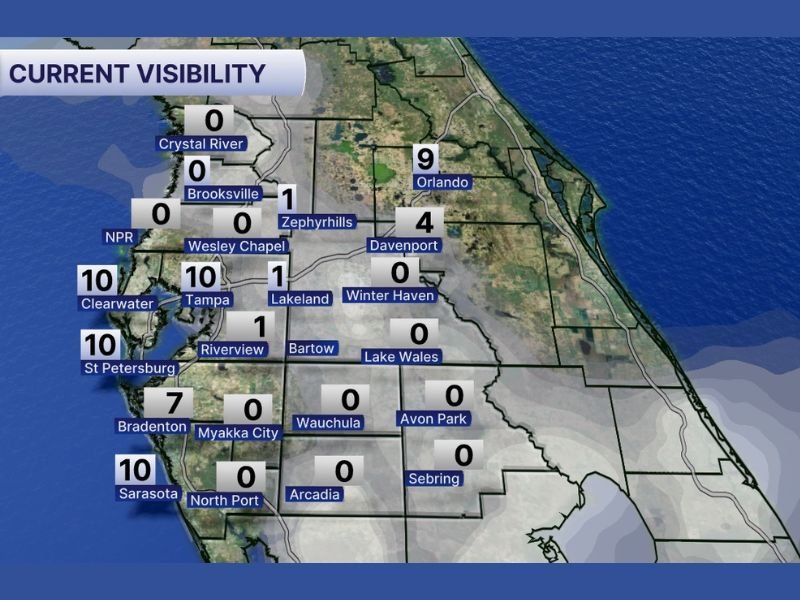
Current visibility data shows several locations reporting near-zero visibility, particularly across inland and interior areas. Cities including Crystal River, Brooksville, Wesley Chapel, Winter Haven, Lake Wales, Wauchula, Avon Park, Sebring, Myakka City, Arcadia, and North Port are reporting visibility at or near 0 miles, indicating extremely dense fog.
Where Visibility Is the Lowest
The most concerning visibility readings are concentrated across interior sections of west-central Florida. Locations north and east of Tampa Bay are seeing the thickest fog coverage.
Communities such as Crystal River and Brooksville are reporting zero-mile visibility, while Wesley Chapel and Winter Haven are also experiencing conditions where drivers may not be able to see beyond a very short distance. Farther south, Sebring, Avon Park, Wauchula, and Arcadia are also under dense fog with visibility readings at zero.
This indicates widespread low cloud development and saturated surface air across the interior region.
Areas Seeing Slightly Better Conditions
Coastal locations are experiencing somewhat better visibility compared to inland areas. Clearwater, St. Petersburg, Tampa, and Sarasota are reporting visibility near 10 miles, suggesting clearer conditions along immediate coastal zones.
However, even in some metro-adjacent inland spots such as Lakeland and Riverview, visibility has dropped to around 1 mile, which can still create difficult driving conditions during early morning hours.
Farther east, Orlando is reporting visibility around 9 miles, while Davenport is down to approximately 4 miles, indicating fog remains patchy but significant in parts of central Florida.
Travel Impacts and Safety Concerns
With several cities reporting zero visibility, motorists should expect sudden reductions in sight distance, particularly along rural highways and less-lit roadways. Fog of this density can develop unevenly, meaning drivers may move from clear air into near-whiteout conditions within a short stretch of road.
Low clouds combined with surface moisture are contributing to this reduced visibility pattern. Morning commuters in affected areas should use low-beam headlights, reduce speed, and allow additional stopping distance.
Conditions may gradually improve later in the day as temperatures rise and mixing increases, but until then, dense fog remains a significant concern across interior west-central Florida.
For continued regional weather updates and developing visibility changes, stay connected with NapervilleLocal.com for the latest coverage.

I’ve lived in Naperville long enough to see how quickly our community changes — from new developments downtown to sudden shifts in our Midwest weather. Reporting on Naperville news and daily forecasts gives me the chance to keep neighbors informed about what really matters. My goal is simple: deliver clear, timely updates so you always know what’s happening in our city and what to expect from the skies above.