
Major Arctic Blast to Hit Tennessee, Arkansas, Georgia, Mississippi, Alabama, the Carolinas and Florida With the Coldest Temperatures of Early 2026
Georgia — A powerful Arctic blast is expected to sweep across the Southeast as the New Year begins, bringing the coldest temperatures of the season to Tennessee, Arkansas, Georgia, Mississippi, Alabama, the Carolinas and Florida. According to early model projections, the cold air will arrive in two phases—one around December 31, followed by an even colder surge on the morning of January 2, 2026.
Two-Part Arctic Outbreak to Close Out 2025 and Begin 2026
Meteorologists say the system will arrive in two pieces, with the first wave of cold air entering the region at the end of December. This initial push will be followed by a stronger and more concentrated surge of Arctic air sweeping across the Eastern U.S. on January 2, delivering widespread freezing temperatures and near-record lows.
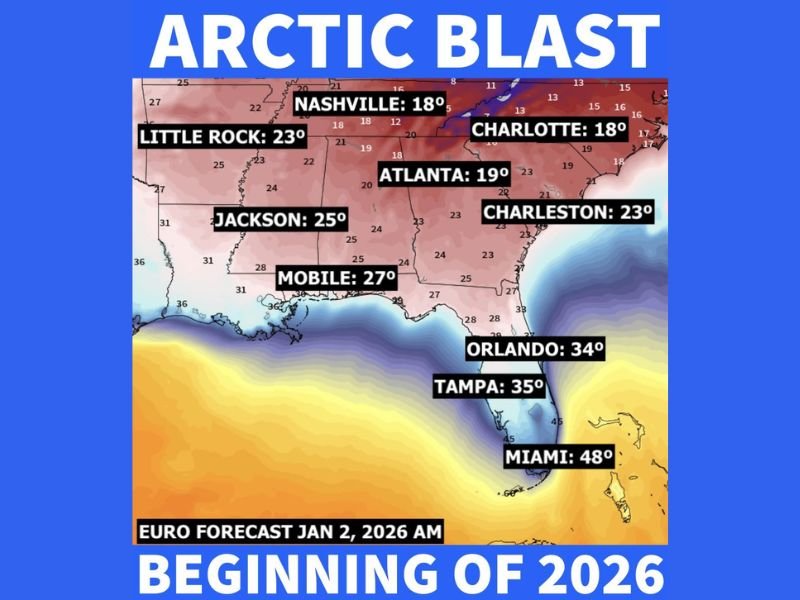
Forecasters note that this event may produce the most intense cold spell of the season for multiple Southeastern states. The Euro model highlights sharp temperature drops into the teens and twenties across a large area, with notable impacts expected from the Deep South to the mid-Atlantic region.
Cities Across the Southeast Brace for Deep Freeze
The temperature map shows a broad stretch of the Southeast falling into unusually cold ranges for early January. Some of the key forecast lows include:
- Nashville, Tennessee: 18°F
- Little Rock, Arkansas: 23°F
- Atlanta, Georgia: 19°F
- Jackson, Mississippi: 25°F
- Mobile, Alabama: 27°F
- Charlotte, North Carolina: 18°F
- Charleston, South Carolina: 23°F
- Orlando, Florida: 34°F
- Tampa, Florida: 35°F
- Miami, Florida: 48°F
These values indicate a widespread and sharply defined Arctic air mass capable of producing multiple freeze warnings, even in typically warmer regions such as central and southern Florida.
Coldest Temperatures of the Season Expected for the Southeast
Forecasters emphasize that this blast will likely be the coldest event of the winter season so far, especially across the Southeastern states. The timing—just after New Year’s Day—means travel disruptions, elevated heating demand and increased risks for exposed pipes or sensitive agriculture.
The second push of cold air, arriving on or before January 2, is expected to deliver the lowest temperatures of the outbreak. Model guidance shows the Arctic air mass penetrating deep into the Southeast, with freezing temperatures extending well into Florida.
Residents Encouraged to Prepare for Hazardous Cold
Because of the widespread nature of the cold outbreak, residents across the affected states are urged to take precautions. The rapid temperature drop could lead to:
- Hazardous travel conditions from overnight icing
- Stress on heating and electrical systems
- Risks to pets, livestock and exposed pipes
- Potential damage to crops and sensitive vegetation
- Higher demand for shelters and warming centers
Meteorologists also note that the cold pattern may be short-lived, but its intensity could pose challenges during morning hours when temperatures are at their lowest. For continuing national weather updates, Arctic outbreak tracking and extended forecasts, visit NapervilleLocal.com.

I’ve lived in Naperville long enough to see how quickly our community changes — from new developments downtown to sudden shifts in our Midwest weather. Reporting on Naperville news and daily forecasts gives me the chance to keep neighbors informed about what really matters. My goal is simple: deliver clear, timely updates so you always know what’s happening in our city and what to expect from the skies above.