
Next Week: Massive Spring Bird Migration Sweeps the Eastern United States With 100–150 Million Birds in Flight Per Night Driven by Rare May-Like Weather Pattern
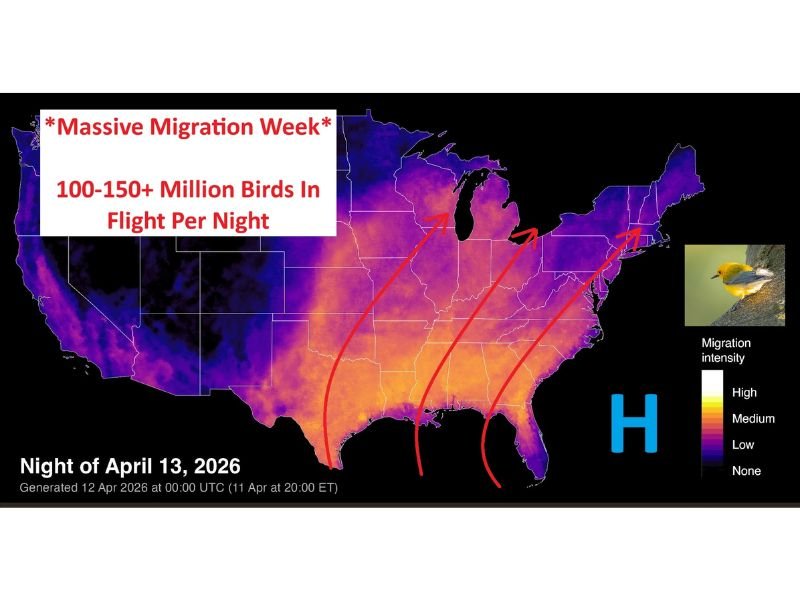
EASTERN UNITED STATES — One of the most significant spring bird migration events in recent memory is set to unfold across the eastern half of the country this week, with forecasters from BirdCast and Purdue University projecting an extraordinary 100 to 150 million birds taking flight per night.
A nearly stationary high pressure system parked on the northern edge of the Bermuda Triangle east of Florida is generating ideal migration conditions that forecasters say are rarely seen this early — more typical of May than mid-April. Bird enthusiasts are being urged to get their feeders out and turn off outdoor lights at night to help the birds migrate safely.
Rare May-Like Weather Pattern Fueling Historic Migration Numbers
The driving force behind this week’s exceptional migration event is a nearly stationary high pressure system sitting on the northern edge of the Bermuda Triangle, just east of Florida. This setup is generating a low-level jet stream approximately 2,000 to 3,000 feet above the ground, producing a constant and smooth southerly wind in the 30 to 40 mph range moving north to northeast throughout the overnight hours.
This type of consistent and powerful tailwind is precisely what migrating birds need to cover enormous distances efficiently each night. The pattern is already locked in and is expected to persist throughout the entire week, meaning the exceptional migration numbers are not a one-night event but rather a sustained multi-night phenomenon.
100 to 150 Million Birds Expected in Flight Each Night
The scale of this migration event is genuinely remarkable. BirdCast and Purdue University’s forecast model — developed by researchers Horton, Jimenez, and Khalighifar — is projecting between 100 and 150 million individual birds in flight per night across the eastern half of the United States throughout the week.
The migration intensity map for the night of April 13, 2026 shows high-intensity migration blanketing a massive corridor from the Gulf Coast through the Great Lakes and all the way into the northeastern United States and New England, with arrows indicating strong northward and northeastward movement across the entire eastern half of the country.
Hummingbirds Among the Species Returning This Week
While the bulk of the migration will occur under the cover of darkness — as most songbirds and other species migrate at night to avoid predators and take advantage of cooler temperatures — hummingbirds are a notable exception. Hummingbirds generally migrate during daylight hours, and this week’s favorable pattern is expected to bring their return to the eastern United States as well.
Residents who have been waiting to put out their hummingbird feeders should do so immediately, as the first arrivals of the season could appear at backyard feeders at any point during the week ahead.
What Residents Can Do to Help the Birds
Wildlife experts and ornithologists are asking residents across the eastern United States to take two simple but meaningful steps to support the migration this week. First, get bird feeders outside and stocked — the influx of migrating birds will be looking for food and rest stops as they travel northward, and backyard feeders can provide critical refueling opportunities.
Second, and equally important, residents are being urged to turn off unnecessary outdoor lights at night throughout the week. Artificial light at night is known to disorient migrating birds, causing them to circle lit structures and exhaust themselves. Reducing light pollution during this peak migration period can make a meaningful difference in helping birds navigate safely to their destinations.
Pattern Expected to Repeat Nightly Throughout the Week
Unlike a single-night migration pulse, this week’s setup is expected to deliver high migration numbers on a repeating nightly basis for the duration of the favorable weather pattern.
Each night through the week should see conditions similar to or exceeding those forecast for Monday night, making this one of the most sustained and productive spring migration windows the eastern United States has seen in years.
Stay with NapervilleLocal.com for the latest weather updates and local forecast coverage.

I’ve lived in Naperville long enough to see how quickly our community changes — from new developments downtown to sudden shifts in our Midwest weather. Reporting on Naperville news and daily forecasts gives me the chance to keep neighbors informed about what really matters. My goal is simple: deliver clear, timely updates so you always know what’s happening in our city and what to expect from the skies above.