
Oklahoma Overtakes Florida as the Nation’s Lightning Capital in 2025, New Data Shows
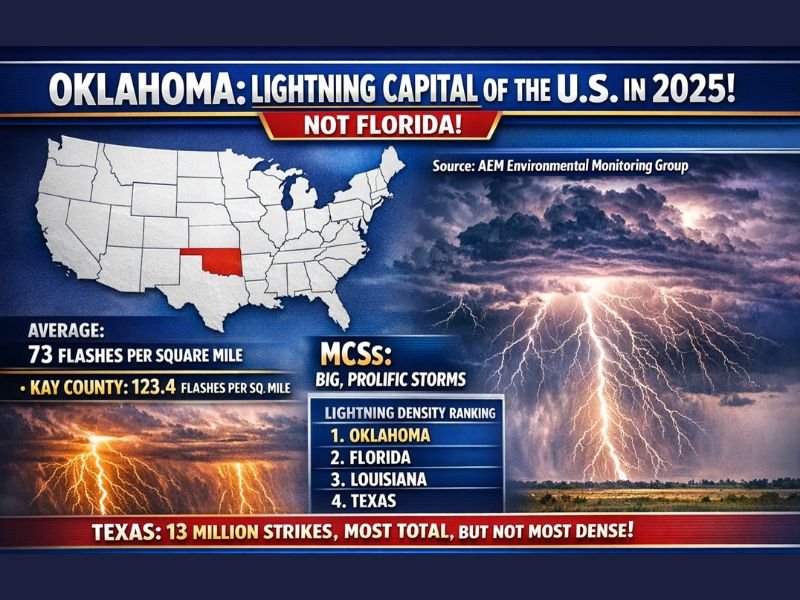
UNITED STATES — Florida’s long-held reputation as the lightning capital of the United States has officially been eclipsed. New data released by AEM Environmental Monitoring Group shows that Oklahoma recorded the highest lightning density in the country in 2025, surpassing every other state on a per-square-mile basis.
According to the report, Oklahoma averaged 73 lightning flashes per square mile, the highest statewide density in the nation. The findings mark a notable shift in lightning activity patterns across the central United States.
Kay County Ranks First Nationwide for Lightning Density
The data shows an even more striking result at the county level. Kay County, Oklahoma, ranked number one in the entire United States, recording 123.4 lightning flashes per square mile — a figure far exceeding typical lightning hot spots. Meteorologists point to repeated rounds of intense thunderstorms across northern Oklahoma as a major contributor to the unusually high concentration of lightning strikes.
Why Oklahoma Surged Ahead of Florida
Researchers attribute Oklahoma’s lightning spike to the frequent development of large thunderstorm complexes, commonly known as mesoscale convective systems (MCSs). These sprawling storm systems can persist for hours, producing prolific lightning as they move across wide areas.
Unlike Florida, where lightning is often driven by daily sea-breeze storms, Oklahoma’s lightning activity in 2025 was fueled by large, long-lasting storm clusters tied to active spring and summer weather patterns across the Plains.
Lightning Density Rankings for 2025
The report ranks states based on lightning density, not total strike counts. The top four states were:
- Oklahoma
- Florida
- Louisiana
- Texas
While Florida remains one of the most lightning-prone states overall, it fell short of Oklahoma in terms of how concentrated lightning strikes were within a given area.
Texas Leads in Total Lightning Strikes — But Not Density
Despite ranking fourth in lightning density, Texas recorded the highest total number of lightning strikes, with an estimated 13 million strikes statewide in 2025. However, Texas’ vast land area means those strikes were spread out more thinly, lowering its per-square-mile ranking.
This distinction highlights the difference between total lightning activity and lightning intensity within smaller regions, which is often more relevant for infrastructure planning, power outages, and public safety.
What the Data Signals Going Forward
Scientists say the findings underscore how lightning patterns can shift year to year based on storm tracks, atmospheric moisture, and large-scale weather setups. The 2025 data reinforces the growing role of the central Plains in producing some of the nation’s most electrically active storms.
As climate variability and storm behavior continue to evolve, experts expect lightning hot spots to change — sometimes dramatically — from one season to the next. Residents across storm-prone regions are encouraged to stay weather-aware, especially during peak thunderstorm months when lightning remains one of the leading weather-related hazards nationwide.

I’ve lived in Naperville long enough to see how quickly our community changes — from new developments downtown to sudden shifts in our Midwest weather. Reporting on Naperville news and daily forecasts gives me the chance to keep neighbors informed about what really matters. My goal is simple: deliver clear, timely updates so you always know what’s happening in our city and what to expect from the skies above.