
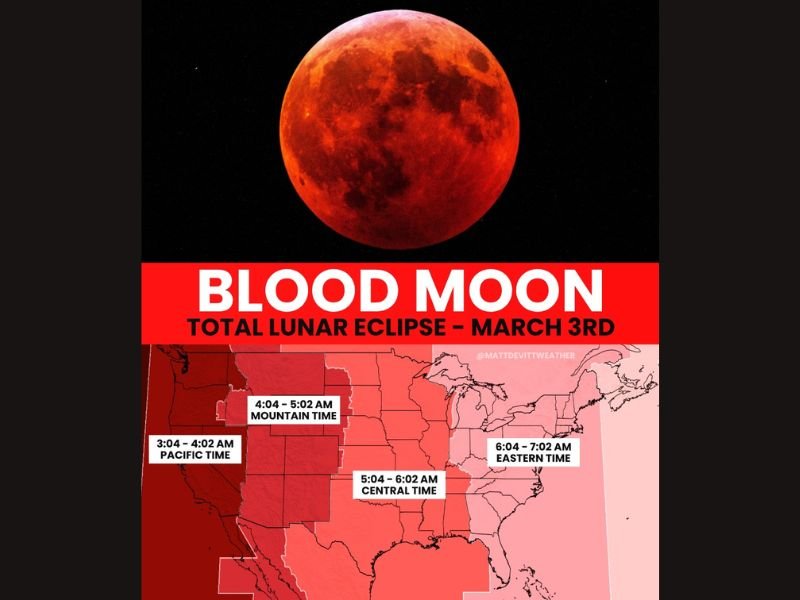
Rare “Blood Moon” Total Lunar Eclipse Turns the Moon Red on March 3 — Exact Viewing Times Across the United States Revealed
UNITED STATES — Skywatchers across the country will witness a dramatic celestial event early Tuesday morning, March 3, as a total lunar eclipse transforms the Moon into a deep red “Blood Moon.”
The eclipse will be visible nationwide (weather permitting), with peak viewing times varying by time zone. For those on the East Coast, the event comes with a rare bonus — a phenomenon known as a “Selenelion,” when the rising sun and eclipsed Moon are briefly visible at the same time just before sunrise.
Why the Moon Turns Red
During a total lunar eclipse, the Earth moves directly between the Sun and the Moon, casting a shadow across the lunar surface. Instead of disappearing completely, the Moon takes on a reddish-orange glow.
That color occurs because sunlight filters through Earth’s atmosphere, scattering shorter blue wavelengths and allowing red tones to bend into the shadow and illuminate the Moon.
The result: a striking crimson Moon hanging in the early morning sky.
Best Viewing Times by U.S. Time Zone
Here are the prime viewing windows for totality — when the Moon appears its deepest red:
- Pacific Time: 3:04 AM – 4:02 AM
- Mountain Time: 4:04 AM – 5:02 AM
- Central Time: 5:04 AM – 6:02 AM
- Eastern Time: 6:04 AM – 7:02 AM
For viewers in the Eastern Time Zone, including states along the East Coast, totality will occur just before sunrise — creating the potential for a Selenelion effect if skies are clear.
The Rare “Selenelion” on the East Coast
A Selenelion happens when the geometry of the Earth, Sun, and Moon allows both the rising sun and the eclipsed Moon to be visible simultaneously above opposite horizons.
This rare alignment can create an unforgettable scene: warm sunrise light in the east while the red Moon lingers in the western sky.
Clear skies will be critical for witnessing this phenomenon.
What You Need to Watch
Unlike a solar eclipse, a lunar eclipse is completely safe to view with the naked eye. No special glasses are required.
For the best experience:
- Find a location away from bright city lights
- Look toward the western sky before sunrise (Eastern U.S.)
- Use binoculars or a telescope for enhanced detail
- Check your local forecast for cloud cover
A Nationwide Celestial Show
Because the eclipse occurs overnight into early morning, viewing conditions will depend heavily on local weather. Those with clear skies will have front-row seats to one of the most photogenic astronomical events of the year.
Whether you’re on the West Coast watching in the middle of the night or on the East Coast catching the red Moon just before dawn, this total lunar eclipse promises a memorable start to March.
For more national weather and sky event updates, stay with NapervilleLocal.com.

I’ve lived in Naperville long enough to see how quickly our community changes — from new developments downtown to sudden shifts in our Midwest weather. Reporting on Naperville news and daily forecasts gives me the chance to keep neighbors informed about what really matters. My goal is simple: deliver clear, timely updates so you always know what’s happening in our city and what to expect from the skies above.