
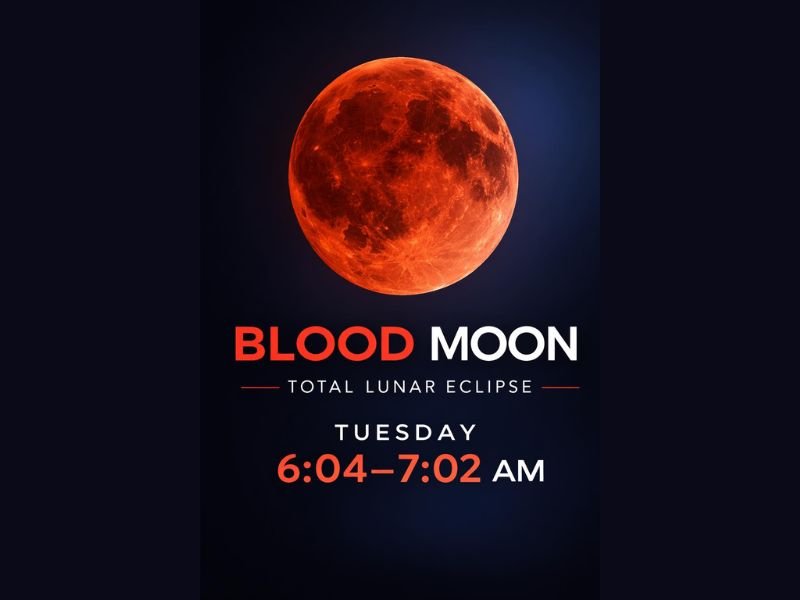
Western Carolinas to See Blood Red Total Lunar Eclipse Tuesday Morning as Earth’s Shadow Turns the Moon Crimson from 6:04 to 7:02 AM
Western Carolinas — Early risers across the region will have a chance to witness a striking total lunar eclipse Tuesday morning, as the moon turns a deep crimson during what is commonly called a “Blood Moon.” The total phase of the eclipse is expected to occur between 6:04 AM and 7:02 AM, offering a narrow but dramatic viewing window before sunrise brightens the sky.
Astronomers explain that during a total lunar eclipse, Earth moves directly between the sun and the moon, casting a shadow across the lunar surface. Instead of disappearing entirely, the moon glows red because sunlight filters through Earth’s atmosphere, bending and scattering shorter blue wavelengths while allowing red tones to pass through.
Why the Moon Turns Red During a Total Lunar Eclipse
The deep red appearance occurs because of a phenomenon similar to what causes colorful sunsets. As sunlight travels through Earth’s atmosphere, particles scatter blue light and allow red and orange hues to dominate. When this filtered light reaches the moon during totality, the surface takes on a dark copper or crimson glow.
Unlike a solar eclipse, a lunar eclipse is safe to watch with the naked eye, binoculars, or telescopes. No special protective glasses are required. Observers simply need a clear view of the western sky before sunrise.
The total phase — when the moon is fully within Earth’s shadow — will last just under an hour, making timing important for those planning to watch.
Cloud Cover May Impact Visibility in the Western Carolinas
While the astronomical alignment is certain, weather conditions could determine how clearly the eclipse is visible. Forecast guidance suggests cloud cover may be an issue across the western Carolinas, potentially limiting viewing opportunities in some communities.
Because the eclipse occurs in the early morning hours, residents will need to set alarms and monitor local sky conditions before heading outside. Even brief breaks in cloud cover could allow glimpses of the deep red moon.
Observers are encouraged to look toward open areas away from bright city lights to maximize visibility. Elevated locations or clear western horizons will provide the best chance of viewing the total phase before dawn begins to wash out the sky.
One of the Most Dramatic Sights in Astronomy
Total lunar eclipses are considered one of the most visually dramatic celestial events. Unlike partial eclipses, which only darken part of the moon, a total eclipse transforms the entire lunar disk into a glowing red orb.
Because lunar eclipses can only occur during a full moon and require precise alignment between Earth, the sun, and the moon, they do not happen every month. Each event varies slightly in color intensity depending on atmospheric conditions at the time.
For residents of the western Carolinas, Tuesday morning presents an opportunity to witness one of astronomy’s most striking natural phenomena — provided the clouds cooperate.
Those planning to watch should prepare in advance, check local forecasts for cloud coverage, and head outside a few minutes before 6:04 AM to avoid missing the start of totality.
For more regional skywatching updates, weather outlooks, and local event coverage, visit NapervilleLocal.com for continuing reports.

I’ve lived in Naperville long enough to see how quickly our community changes — from new developments downtown to sudden shifts in our Midwest weather. Reporting on Naperville news and daily forecasts gives me the chance to keep neighbors informed about what really matters. My goal is simple: deliver clear, timely updates so you always know what’s happening in our city and what to expect from the skies above.