
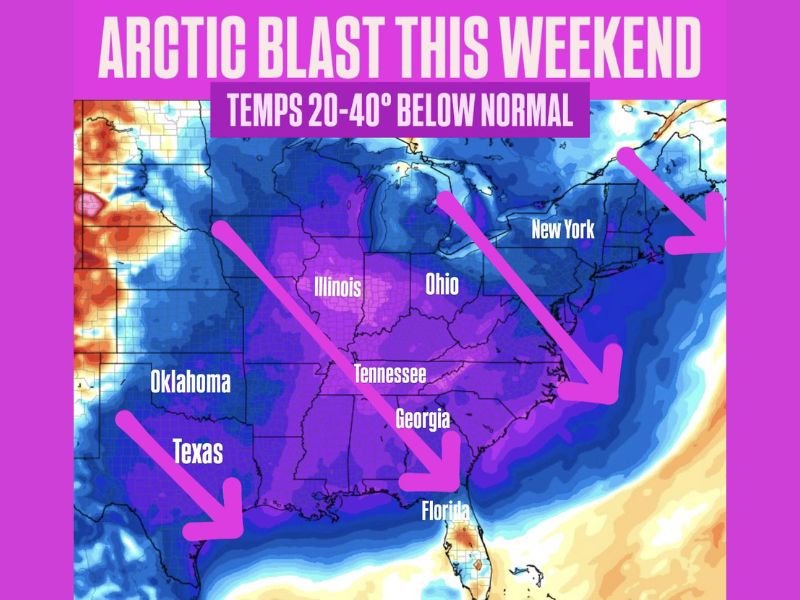
Arctic Blast to Drive Temperatures 20–40 Degrees Below Normal Across the Midwest, Great Lakes, Ohio Valley, and Down Into Texas, Tennessee, Georgia, and Florida This Weekend
United States — A surge of Arctic air is sweeping across the northern Rockies and will push rapidly southeast through the Northern Plains, eventually reaching the Midwest, Great Lakes, Ohio Valley, and even the Gulf Coast by this weekend. Forecast models show an exceptionally cold airmass, with temperatures falling 20 to 40 degrees below normal in several regions, making it one of the coldest events of the season so far.
Coldest Temperatures Targeting the Midwest, Great Lakes, and Ohio Valley
Meteorologists report that the most significant temperature drops will occur across Illinois, Indiana, Ohio, Michigan, Wisconsin, Iowa, and Minnesota, where highs will struggle to reach levels typical of mid-winter, not early-season cold. Some locations in the Great Lakes and Ohio Valley may experience anomalies up to 40 degrees below average, signaling an intense and widespread Arctic intrusion.
The harshest conditions are expected late Friday through the weekend, with wind chills dipping even lower, creating hazardous conditions for exposed skin and increasing the risk of frostbite.
Arctic Air Extending Into the South and East Coast
While the core of the cold settles over the central and northeastern United States, the Arctic front will also bring 10–20 degree below-normal temperatures to the Southern Plains and Deep South. States including Oklahoma, Texas, Tennessee, Georgia, and northern Florida will see temperatures plunge far below seasonal norms.
Although these areas typically avoid deep winter cold, forecasters warn that the contrast between normal December temperatures and the arriving Arctic air will be substantial, with nighttime lows falling quickly once the front passes through.
New York and Eastern States to Experience a Sharp Chill
The Arctic mass will also stretch toward the Mid-Atlantic and Northeast, including New York and surrounding states, where temperatures will drop significantly heading into the weekend. While the eastern U.S. may not see anomalies as extreme as the Midwest, the region will still face a pronounced and abrupt cold wave.
Travel and Safety Concerns Expected This Weekend
The American cold wave is expected to influence:
- Road travel, especially during early morning hours
- Outdoor events and holiday activities
- Livestock and agricultural operations in typically milder states
- Energy demand across multiple regions
Residents across affected areas are urged to prepare for rapid temperature drops, bundle appropriately, and monitor local updates.
For continued coverage of this Arctic outbreak and updates on regional temperature impacts, visit NapervilleLocal.com.

I’ve lived in Naperville long enough to see how quickly our community changes — from new developments downtown to sudden shifts in our Midwest weather. Reporting on Naperville news and daily forecasts gives me the chance to keep neighbors informed about what really matters. My goal is simple: deliver clear, timely updates so you always know what’s happening in our city and what to expect from the skies above.