
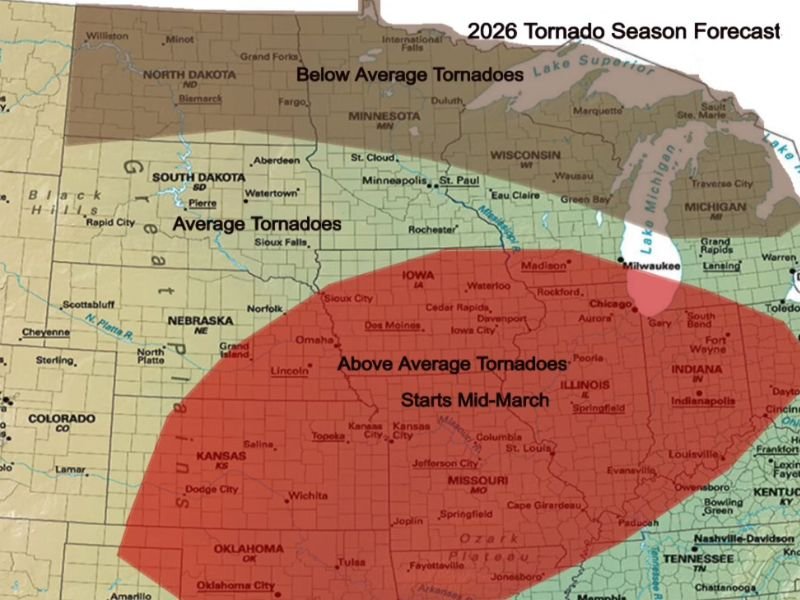
2026 Tornado Season Forecast: Above-Average Risk from Oklahoma and Kansas Through Missouri, Illinois, Indiana and Iowa Starting Mid-March
United States — The 2026 tornado season forecast indicates an above-average risk across portions of the Central Plains and Corn Belt, with activity expected to ramp up quickly beginning in mid-March.
The outlook map highlights a broad red-shaded zone labeled “Above Average Tornadoes” stretching from Oklahoma and Kansas northeastward through Missouri, Iowa, Illinois, and Indiana . This region includes major population centers such as Oklahoma City, Wichita, Kansas City, St. Louis, Des Moines, Chicago, and Indianapolis.
Where Tornado Risk Is Expected to Be Highest
According to the forecast, the most active corridor for tornado development in 2026 is expected across:
- Oklahoma
- Kansas
- Missouri
- Iowa
- Illinois
- Indiana
The forecast notes that tornado season is expected to start ramping up in the middle of March, with several periods of southwest flow contributing to a more favorable severe weather pattern.
Southwest flow aloft often supports organized severe thunderstorms by enhancing wind shear and moisture transport from the Gulf of Mexico. When combined with warming spring temperatures, this setup can increase the frequency of severe weather episodes.
Areas Expected to See Average or Below-Average Activity
Farther north, the map shows a zone of “Below Average Tornadoes” north of Interstate 90, covering much of Minnesota, Wisconsin, North Dakota, and northern Michigan .
A lighter-shaded band through parts of South Dakota and southern Minnesota is labeled as near-average activity. While tornado frequency may be lower in these northern areas compared to the central corridor, overall precipitation is still expected to remain active.
This north-to-south gradient suggests that the primary focus for severe weather in 2026 may concentrate slightly farther south than some previous seasons.
What to Expect This Spring
The forecast also suggests that while March and April could see active tornado periods, May may trend somewhat quieter for tornado counts, though western ridging could increase the risk for damaging wind events as the season progresses.
An above-average tornado outlook does not guarantee continuous outbreaks, but it does increase the probability of multiple severe weather episodes throughout the spring.
Residents across the Central Plains and Midwest — particularly from Oklahoma through Illinois and Indiana — should begin reviewing severe weather preparedness plans as peak season approaches.
With tornado season expected to ramp up quickly by mid-March, monitoring forecasts and staying weather-aware will be critical in the coming weeks.
For continued severe weather outlooks and regional forecast updates, visit NapervilleLocal.com for in-depth coverage and analysis.

I’ve lived in Naperville long enough to see how quickly our community changes — from new developments downtown to sudden shifts in our Midwest weather. Reporting on Naperville news and daily forecasts gives me the chance to keep neighbors informed about what really matters. My goal is simple: deliver clear, timely updates so you always know what’s happening in our city and what to expect from the skies above.