
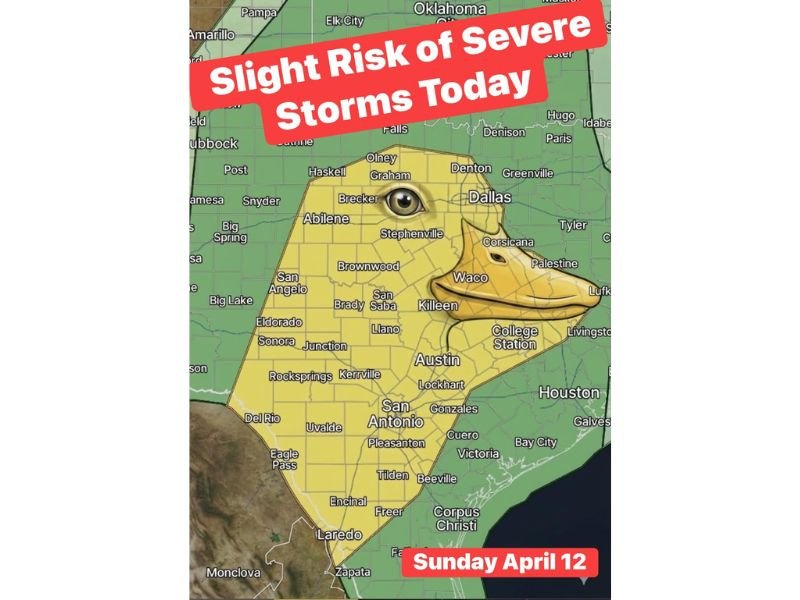
The “Weather Duck” Has Texas in Its Sights: A Highly Uncertain Slight Risk of Severe Storms Threatens Dallas, Austin, San Antonio, and Houston This Sunday
DALLAS, Texas — Meteorologists are eyeing a uniquely shaped severe weather risk zone sprawling across a massive stretch of Texas this Sunday, April 12, 2026 — one that has forecasters noting it bears a striking resemblance to a large duck head on the map. Jokes aside, the threat is real.
A Slight Risk of severe weather covers a broad area from the Oklahoma border through central and eastern Texas, stretching all the way down to the Gulf Coast. The catch? Storm development is highly conditional and uncertain, but if storms do manage to break through the atmospheric cap, they could quickly become dangerous supercells.
Highly Conditional Setup — But Dangerous If It Fires
The defining characteristic of today’s severe weather setup is uncertainty. Storm development is entirely dependent on whether the atmospheric cap — a layer of warm air that acts as a lid suppressing storm formation — can be broken through during the afternoon heating hours.
Most high-resolution weather models are sending mixed signals, making this one of the more difficult forecasts to pin down. However, the atmosphere has enough instability and shear loaded into it that if even one or two storms manage to punch through the cap, the environment around them would be highly supportive of rapid intensification into supercells.
Large Hail, Damaging Winds, and a Tornado or Two Possible
Should storms develop today, the threat profile is significant. Any storm that forms near the lingering boundary across central and eastern Texas or along the western dryline could quickly organize into a supercell thunderstorm capable of producing large hail, damaging wind gusts, and potentially a tornado or two.
The combination of a favorable wind shear profile and sufficient instability means that isolated storms would not need long to become serious hazards. Residents across the risk zone should have a weather alert plan in place even if the morning looks quiet and storm-free.
Risk Zone Stretches From Dallas and Abilene Down Through Austin, San Antonio, and Houston
The Slight Risk zone covers an enormous footprint across Texas, taking in a wide range of major population centers. Communities from Amarillo and Lubbock in the north through Abilene, Dallas, Waco, and Killeen in the central zone and extending southward through Austin, San Antonio, and all the way to Houston, Corpus Christi, and the Gulf Coast are all within the outlined risk area.
Residents from the Red River along the Oklahoma border down to the Rio Grande Valley near Laredo and Zapata fall somewhere within the broader threat zone today.
Stay Weather Aware Through the Afternoon and Evening
Given the highly conditional and uncertain nature of today’s setup, residents across Texas should resist the temptation to let a quiet morning lower their guard. Storms, if they develop, could do so quickly and intensify rapidly during the peak afternoon heating hours and into the evening.
Keep weather alerts active on your phone, know your nearest shelter location, and stay tuned for updated forecasts throughout the day. Stay with NapervilleLocal.com for the latest weather updates and local forecast coverage.

I’ve lived in Naperville long enough to see how quickly our community changes — from new developments downtown to sudden shifts in our Midwest weather. Reporting on Naperville news and daily forecasts gives me the chance to keep neighbors informed about what really matters. My goal is simple: deliver clear, timely updates so you always know what’s happening in our city and what to expect from the skies above.